
Instinctual Record Collecting and Storytelling: Honoring our elders and ancestors at the BMC 50th anniversary celebration
Updated: Sep 29
By Hayley Brooks
I am not one to sing in groups. In Mennonite contexts, I am an anomaly for this. In my evangelical church, I could never raise my arms or put them out in front of me. My shame stopped me. If I could, I would hide under the chairs (not pews) during worship or stare blankly at the projector screen, usually filled with a gradient background and lyrics like “I may never fly over the enemy but I’m in the lord’s army” or “power and majesty praise to the king.” However, when I couldn’t sleep as a child, I would whisper "Jesus Loves Me" to myself between sobs until I wore myself out enough to fall asleep. There are moments I still do this in adulthood.
The evangelicals I grew up with are not particularly into maintaining traditional ritual. They love novelty and removing historical context from their rites and rituals. This is, of course, a fallacy. They are not inventing anything new so much as regurgitating centuries old colonialism and patriarchal values. The draw of evangelicalism for many people has been the branding and political power. In the moments after Columbine and 9/11, I witnessed and participated in the church branding those events as a sign of the end times. I was told, explicitly and implicitly, that feminism, sexual liberation, Obama’s election, and the gay rights movement accelerated the coming of the rapture.
When I first encountered Mennonite hymn sings at Goshen College, the four part harmony intimidated me. The speedy page turning to the relevant hymn reminded me of Bible Drills, where you would win a prize if you were the first one to find a specific verse. Before Bible Drills, you were required to disqualify yourself if you had added tabs marking each book. I never had the tabs but I had acquired a bible cover with a crossbody strap at a college bookstore that was the envy of many girls in youth group. I found solace in knowing I was not breaking the rules, though I was never very good at the drills.
I still can’t lift my arms up during communal singing, I don’t know that I ever will — but I am deeply grateful that I have witnessed singing as ritual throughout my time with BMC. I don’t feel the need to be an active participant for those rituals to heal something in me. At the 2015 MCUSA convention, when Pink Menno began the Pink Forest action, I felt the emotional turbulence of my childhood resurface. The silence, the pause, and the firmness with which we stood was both deeply traumatic and healing. The song Christian Parks led us in singing at the end of the action, “There is More Love Somewhere” by Steve Biko of the South African apartheid movement, brought me back to my body.
The 50th anniversary celebration coincided with a time of recovery in my life. I left a job and a relationship that disconnected me from myself a few months ago. I left myself behind, I stopped listening to my instincts, I quieted the parts of myself I love the most. Trauma disrupts narratives; rebuilding a cohesive narrative is part of the process of healing. In my old way of understanding the world, I would give myself alongside Jesus or God all the credit for this wisdom. The last decade I have spent growing and learning with BMC has taught me that my elders and ancestors are responsible for this, that I carry them with me.
Jim Lichti made this very clear to me during the storytelling on Saturday night and a conversation we had the following morning. Earlier in the day, Tretter Collection curator Aiden Bettine and I had a conversation about Barbara Gittings and a presentation/paper I had written about her during my graduate program in library science at St. Kate’s. Jim spoke of passing out a brochure titled “What is an appropriate Christian response to homosexuality?” at the 1979 Mennonite convention in Waterloo with Beth Sutter and her then-husband Biff. Martin Rock, Jim, and a few others met with Barbara Gittings before the convention and she gave them advice about handing out this literature based on her time with the Task Force on Gay Liberation (now the Rainbow Round Table) at the American Library Association. Aiden and I locked eyes with our jaws dropped when Jim described this moment.
The following morning, I stopped Jim and told him about my paper. As we spoke, we made the connection that the action I participated in with Jay Yoder, Doran Stucky, and others at the 2015 MCUSA convention was similar in many ways to Jim’s action in 1979 — we passed out fake resolutions prior to storming the stage about those “struggling with opposite-sex attractions at variance with the mennonite confession of faith” not being eligible for membership in the church.1 I remember an “ally” telling me that passing out literature in the delegate hall was against the rules. I furrowed my brow and told him I would find someone else to take that risk for us then. And I did. I think Jim, Barbara Gittings, and Beth and Biff were speaking through me in that moment.
Jim and I also spoke about my upbringing and my time at Goshen College. When I left the evangelical church when I was 16, I didn’t know what I was doing. At Goshen College, I came out in The Record2 and wrote many other articles in defense of LGBTQ people and justice. I told Jim I didn’t always know what motivated me to protect myself and others like this, or where my fierceness came from. I could give myself credit for that, but that would be disingenuous. The work of elders and ancestors like Jim, Carol Wise, John Linscheid, Wendy O’Neal, Jim Wegner, Barbara Gittings, Mary Oliver, Stormé Delarverie, Carter Heyward — more than I can ever name — propelled me forward, created that fierceness and courage. I am because we are.
There have been a lot of public conversations about epigenetics and the passage of trauma across generations along racial lines. I think there is a lot of value in having these conversations and in the research dedicated to understanding this phenomenon. I am also conscious of biological essentialism and wonder if we might be missing a piece of the conversation if we are solely looking at this from the lens of reproduction and race. I am firm in my belief that no one is irredeemable or inherently evil. I don’t need a scientific study to tell me that I carry the work of my queer and lesbian ancestors in my body. In fact, I don’t think scientific study has much to offer me there.
In 2013, the theater troupe Theatre of the Beat came to campus and performed Gadfly, a play about Sam Steiner and his time at Goshen College. Prior to their arrival, my writing professor assigned a 2009 article in the Center for Mennonite Writing Journal written by Daniel Hess in the Mennonite literature class I was taking at the time. In the article, Hess details the history of Menno Pause, a controversial underground newspaper at Goshen College. Steiner was one of four editors of the paper, as well as Jim Wegner. Hess explained that a personal ad soliciting a male partner placed by Wegner was found by college administration and was the impetus for his expulsion and the expulsion of the three other editors.3 In Gadfly, Jim’s story was completely erased. I felt deeply disappointed by this and wrote about it in The Record.4 I dug through every copy of Menno Pause available in the Mennonite Historical Library in order to understand this history. Theatre of the Beat did respond to my article and thanked me for it – I think this was likely the first time I experienced repair in an institutional context.5
This act of record and story collecting has become the foundation of my personal, spiritual, and professional life. Aiden and I spoke extensively throughout the weekend about the role of archives and storytelling in understanding ourselves and the world. BMC’s work has primarily functioned in this way for me — the act of remembering, collecting, telling, speaking. This is how we create ourselves, how we become, commune. This is deeply instinctual work for me. Sometimes it feels emergent, feverish, chaotic, but it offers clarity and hope in the long term. It is how we sustain ourselves and future generations. BMC and the 50th celebration have offered me ways of knowing that honor my instincts. This has been an incredible gift and passage back to myself.
Hayley Brooks (she/her) is a lesbian poet, writer, and digital archivist based in Philadelphia, PA. Hayley served as the Kaleidoscope Coordinator for BMC from 2015 to 2017 and Communications Associate from 2018 to 2024. She is currently the Manager of Digital Services at the Historical Society of Pennsylvania. Hayley lives with her three-legged cat, June, and a growing collection of typewriters and small analog audiovisual equipment.
1 Dean, Matt. “Pink Menno Press Release on July 2, 2015 Action at Mennonite Church USA Convention.” Pink Menno, July 2, 2015. http://www.pinkmenno.org/2015/07/pink-menno-press-release-on-july-2-2015-action-at-mennonite-church-usa-convention/.
2 Brooks, Hayley. “Safety, Risk and Reclaiming Silence.” The Record, September 12, 2012, sec. Opinions. https://record.goshen.edu/opinion/safety-risk-and-reclaiming-silence.
3 Hess, Daniel. “Menno Pause Revisited.” Center for Mennonite Writing Journal 1, no. 6 (May 15, 2009). https://mennonitewriting.org/journal/1/3/menno-pause-revisited/.
4 Brooks, Hayley. “Queer Erasure and Representation in Gadfly.” The Record. October 13, 2013, sec. Opinions. https://record.goshen.edu/opinion/queer-erasure-and-representation-in-gadfly.
5 Theatre of the Beat, “When Gadflies Don’t Buzz Quite Enough,” Beat Blog, October 21, 2013, https://theatreofthebeat.wordpress.com/2013/10/21/when-gadflies-dont-buzz-quite-enough/.
Audio of Pink Menno and supporters singing “There is More Love Somewhere” by Steve Biko of the South African apartheid movement, led by Christian Parks at the 2015 MCUSA Convention in Kansas City on July 2, 2015. From video taken by Hayley Brooks, CC BY-NC-SA 4.0.
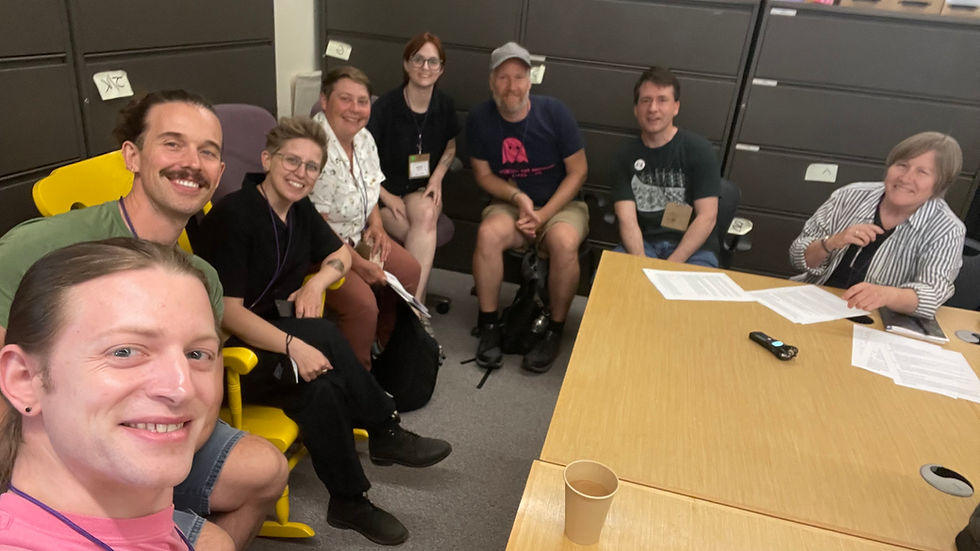
Photo identification left to right: Pax Ressler, Philip Kendall, AB Roeschley, Katie Hochstedler, Hayley Brooks, Tim Nafziger, Luke Miller, and Carol Wise following the Pink Menno interview for BMC’s oral history project at the Tretter Collection at the University of Minnesota on May 30, 2026 at BMC’s 50th anniversary celebration. Photo taken by Pax Ressler.


Comments